J'ai donné à une IA les plans d'une expérience de sûreté nucléaire. Elle a prédit les mesures.
Correction — July 2026. A later source review found problems with this benchmark that invalidate specific numbers below. Most important: the input pack disclosed a design thermal-duty value close to the held-out quantity the agents were asked to infer, so the “blind prediction” framing overstates the case. The review also found a peak-window average from the source report described as a maximum, and a whole-system radiation fraction and a post-peak cooldown stated without support in the measured record. The physics walkthrough and the method stand; treat the quantitative agreement as unverified. Corrected packs and the full defect list are in the repository: https://github.com/charles-azam/eng-bench#what-changed-after-auditing-the-benchmark
TL;DR. I gave Claude the geometry, materials, and heater settings of a US national-lab passive-cooling experiment and asked it — like any engineer — for a calculation note. Working autonomously on a cheap VPS, it built physics models from textbook first principles and predicted the lab’s measured airflow within ~4% in six of seven runs, the vessel-wall temperature within −8…+8%, and correctly called the accident-transient outcome every single time. It also got things wrong in instructive ways, and an independent adversarial AI audit of my own claims found real issues — all published. Everything is in the repo, transcripts included. The twelve-run campaign cost ~$61 (four later Fable 5 runs, graded separately, added ~$27).
Original repository: eng-bench
The experiment
Modern high-temperature reactor designs claim they can survive a total blackout with a cooling system that has no pumps and no moving parts: the hot reactor vessel radiates heat across an air gap to a wall of steel ducts, and the warmed air rises up a chimney on its own. To license that claim, Argonne National Laboratory built NSTF — a half-scale, 26-metre-tall rig: an electrically heated steel wall standing in for the vessel (up to 220 kW), twelve steel riser ducts, two chimneys, ~400 sensors, nuclear-grade QA, 33 months of testing. If you want the physics of why this works (and how the weather gets a vote), that’s a companion post.
The point here: this produced years of public, measured truth about a system doing pure physics. Which makes it a perfect exam for a different question — can an AI, given only what a design engineer would have, predict what the lab measured? Not “can it run a simulation someone set up.” Can it do the engineering: pick the physics that matters, build the model, defend the assumptions, and land on reality?
The setup
Each run got a folder and one prompt. The folder: an engineering brief (“produce a calculation note; I want the airflow, the temperatures, the radiation/convection split, the accident case, the weather sensitivity”), and four input files — geometry, materials, sensor locations, boundary conditions. Facts only; no measured results; no method hints. The rules: build from first principles; install whatever software you want; do not look up this facility’s published data.
One disclosure before the results, because it matters: the boundary conditions included the facility’s design duty (“82 kW electric ≈ 56 kW scaled thermal duty”) — a normal thing to give an engineer, but that pairing quietly encodes the rig’s measured heater efficiency. The agents’ own loss estimates disagreed with it (they computed 66–72 kW should reach the air); all but one trusted the given number anyway. Remember that — it explains their one systematic miss.
I ran this twelve times over three days, eleven runs on Claude Opus: seven baseline runs (one with the facility identity scrubbed, one on inputs curated by a separate agent from the raw report, two additionally required to cross-check themselves with CFD — more on that below), one with a weaker model (Sonnet), one on blind scenarios the prompt had never mentioned, two asked for things nobody measured the usual way (a blind correlation derivation and a full-plant scale-up), and one early run whose server I deleted before archiving it (excluded from every claim here). 6–57 minutes each. About $61 of API total, including the separate curator agent, the probes, and the audit.
What came back
Every run independently chose roughly what a good thermal-hydraulics engineer would: a radiation network across the cavity (hot things glow as T⁴ — that’s how ~80–90% of the heat crosses the gap), textbook convection correlations for the duct interiors, and a buoyancy-vs-friction loop balance for the flow — solved in a few hundred lines of Python it wrote from scratch, with cited correlations (Gnielinski, Churchill–Chu, Sutherland). No CFD mesh needed to get the numbers: the compute cost of the physics is milliseconds. The judgment is the product.
Against Argonne’s measurements (their baseline test, 82 kWe):
| Quantity | Measured | Seven Opus runs | Verdict |
|---|---|---|---|
| Loop airflow | 0.574 kg/s | 0.55 – 0.65 | within ~4% in six runs; +13% in one |
| Vessel-wall temperature | 390.7 °C | 359 – 420 °C | −8…+8% |
| Riser duct wall | 163.1 °C | 110 – 195 °C | −32…+20% |
| Air temperature rise | 84.1 °C | 96 – 110 °C | +14…+31% high, every run |
| Radiation carries the heat? | yes, ~80% | yes, 87–93% | right regime, fraction too high |
The +13% flow outlier is its own story: that run was the only one to reject the supplied heat duty and trust its own heat-loss physics instead — and its numbers moved exactly as that choice predicts. Same physics, different judgment call, self-consistent either way.
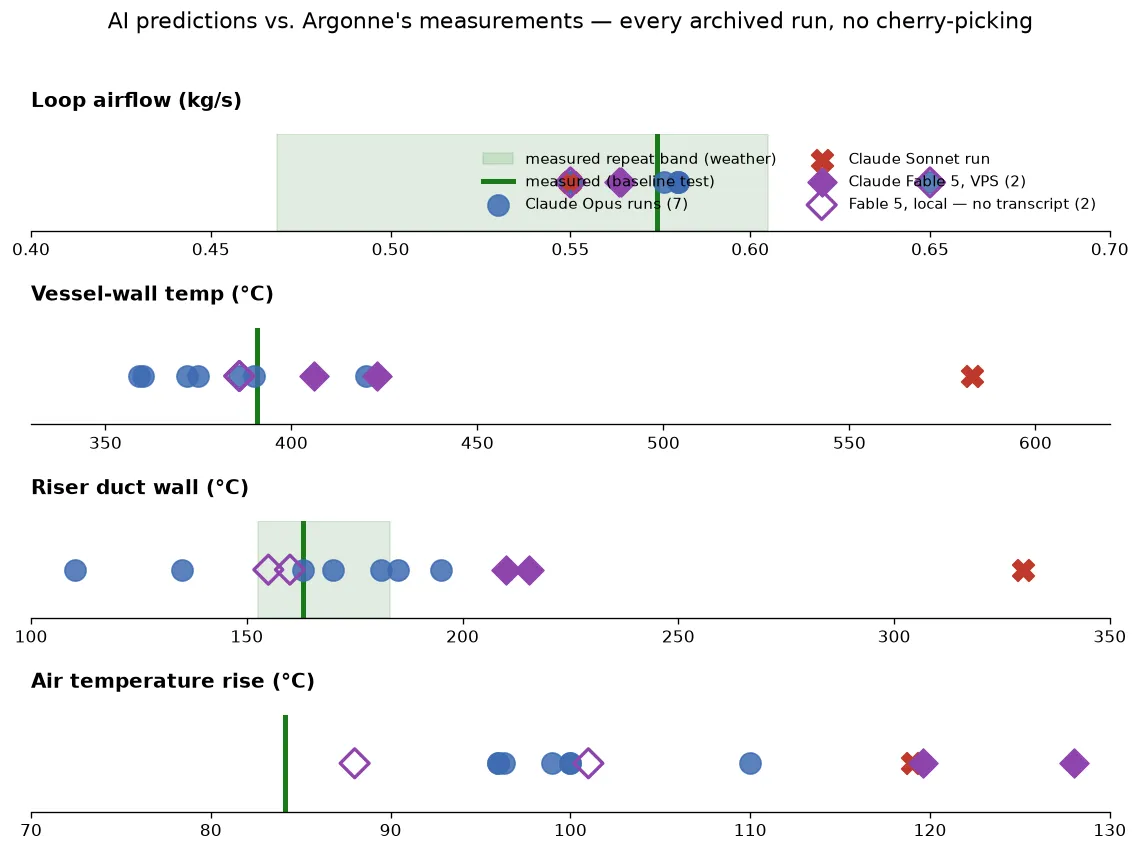
Two things to say like an adult. First, the best run landed on 163 °C and 390 °C — within 0.2% of measurement. That’s luck inside a ±5–10% assumption band, not accuracy; judge the ensemble. Second, the air-ΔT miss is systematic, and it’s the supplied heat duty: every run flagged that exact input as its riskiest assumption before any comparison existed. (The facility’s own energy accounting is ambiguous at the ~13% level between two ways of measuring heat-to-air — the agents’ overshoot sits inside that ambiguity, but a miss is a miss.)
Two runs had to cross-check themselves with CFD. The first installed OpenFOAM in Docker, unaided, built a cavity case with surface-to-surface view-factor radiation, and reconciled the radiative fluxes with its own hand-built network to within 2% — in 27 minutes, for $8.71. (Scope honesty: that case verified the radiation arithmetic at prescribed temperatures.) So the second was required to do it the hard way: prescribe only the heater flux and let the solver find the temperatures. It chose discrete-ordinates radiation with a k-ω SST model, invented a flux-ramping scheme to converge the stiff radiation coupling, and got wall temperatures — as outputs — within ~10% of its hand model, radiation share 89%, disclosing its own remaining energy-imbalance caveat. That’s 57 minutes and $16.42 for what a thermal-hydraulics consultancy would happily bill a week for.
The accident that saves itself
The marquee test at Argonne: drive the wall with a scaled reactor decay-heat curve — 3.5 days of slowly rising then fading heat — and see if passive cooling keeps up. Measured: the wall climbed to ~409 °C, flattened, and came back down. The rig saved itself.
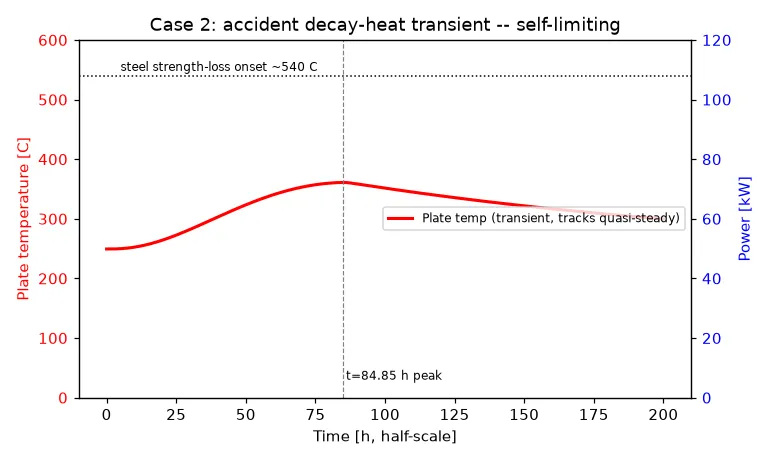 (Figure produced by the agent itself during its run, unprompted.)
Every single run — even the weak-model one — predicted that outcome, with the right argument: radiated power grows as temperature to the fourth power, and the chimney draft strengthens with heat, so every degree of warming buys disproportionately more cooling. Negative feedback everywhere; nothing to run away. Opus runs put the peak at 359–391 °C (−4 to −12%), classified it “levels off, no runaway,” and stated safety margins. Several runs also caught that the decay-curve polynomial I’d supplied was corrupt (a missing coefficient made it diverge), refused it, and used the stated curve shape instead.
The blind round
Then I gave one fresh run three scenarios whose measured outcomes I held back, chosen because they’re weird:
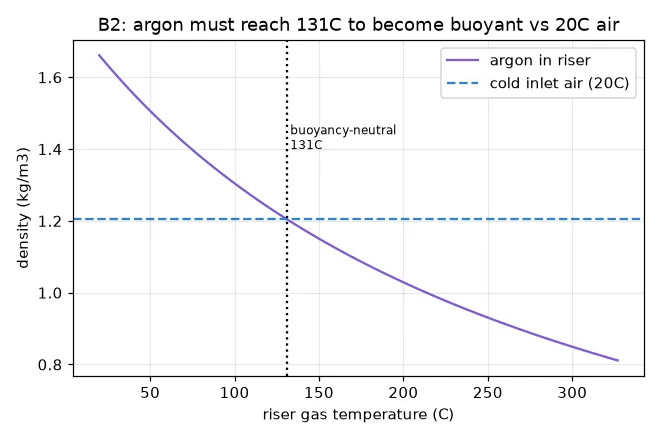
Argon flood. Dump heavy argon gas into the loop’s intake. Measured: circulation collapsed to a dead stop within ~90 seconds, gas temperatures spiked to 126 °C, and the loop restarted itself about 30 minutes later. Predicted, from scratch: a “density lock” — the heavy cold gas kills the buoyancy and stalls the loop in seconds-to-tens-of-seconds; the trapped heat then warms the argon until it becomes buoyant again at a computed threshold of 131 °C, and the loop purges itself in minutes (measured: ~30). Mechanism, order-of-magnitude timescales, and a 5 °C hit on the restart temperature — on physics alone.
Block half the cooling ducts. Prediction: airflow drops 40% (measured: 37% — good) and the wall heats up ~100 °C. Measured: it barely rose 13 °C. Wrong by a factor of eight — and the agent had pre-registered the exact cause in its confidence notes: it assumed blocked ducts stop absorbing radiation; in reality they sit there and keep soaking heat. The miss was flagged as a risk by the thing that made it. That’s what an honest model looks like.
Winter vs summer accident. It correctly ranked which temperatures move with the weather and which are protected (the vessel wall barely notices — the T⁴ radiation clamps it), though it under-predicted how much the airflow shifts.
”It’s just in the training data”
The objection everyone should raise. What I found:
- Asked directly, from memory, for the measured values of this exact test, Opus, Sonnet, and Haiku all refuse — Opus’s words: “I don’t reliably remember these specific measured values… any numbers I produced would be fabricated.” Forced to choose among five options anyway, they score 6/16 — statistically indistinguishable from guessing (and the analysis in the repo discloses a design flaw that explains the apparent hits).
- But they recognize the facility. Given just the geometry, Opus and Sonnet name NSTF and Argonne. So scrubbing names is cosmetic — which is why I also reran the experiment with a de-identified pack. It scored as well as the identified runs (flow within +1%).
- The transcripts are published. Every command of every surviving run: zero web searches, zero document fetches (one run pinged hub.docker.com before pulling the OpenFOAM image — it’s in the log). Several runs wrote their own air-property functions from Sutherland’s law; others pip-installed CoolProp; none fetched anything about the facility. The measured data never existed on that machine.
- The errors are the tell. Independent runs missing the same quantity, in the same direction, for the same self-stated reason — and a blind-scenario miss whose cause was pre-flagged — is the signature of derivation, not retrieval. Memorized answers don’t come with consistent, explainable mistakes.
- Even the inputs weren’t mine, in the end. Our audit noted I had curated the input files while holding the answers. So a separate agent re-derived the inputs directly from the raw report under a written no-outcomes protocol (gate-checked before use), and a fresh run on that pack produced the best baseline numbers of the whole campaign — airflow +0.3%, vessel wall −1.3%. That pack legitimately contained the design-intent flow value; the agent explicitly rejected it in favor of its own momentum balance, and the measurement sided with the agent.
Can I prove latent memory didn’t subtly steer an assumption somewhere? No — nobody can, and you should distrust anyone who claims to. What I can do is publish everything and let you grep.
Then I set an AI on my own claims
Before writing this post, I gave a fresh Claude instance — no context, adversarial charter — the whole repo and told it to tear the claim apart. It ran the agents’ model code itself to verify the numbers weren’t hardcoded, grepped the inputs for leaked values, inspected the CFD case, and came back with: “supported with corrections” — plus a list of eight real problems: my headline oversold the luckiest run, hid the ΔT miss, didn’t disclose that the given heat duty encoded a measured efficiency, and claimed a “transcript audit” without publishing transcripts.
Every correction is applied above, and the audit is in the repo, unedited. If an AI is going to do engineering, this is the shape I think trust has to take: not “the model is smart,” but adversarial review plus published evidence, all the way down.
What a weaker model does
Same folder, same prompt, Sonnet instead of Opus: it got the loop hydraulics right (flow −4%, weather trend close) but made one structural mistake in the radiation network — and predicted a vessel wall of 583 °C, hot by 49%, with the duct wall off by a factor of two. It also took 3× more turns to finish. Interestingly, it still called the accident “bounded, no runaway” — the qualitative safety physics is robust even when the numbers aren’t. The gap between “sounds like an engineer” and “lands on the measurement” is exactly the frontier-model edge, and it’s why this project works now and didn’t two years ago.
What a newer model does
I later ran the same frozen pack four times on Fable 5 (Anthropic’s newest tier; two runs on the VPS with full transcripts, two earlier ones as local subagents — graded separately in the repo). The interesting part isn’t the accuracy, though the transcript-backed runs’ flows (−1.7%, −1.8%) were among the campaign’s best and their vessel walls solid (+8.3%, +3.9%). It’s the judgment: both VPS runs independently rejected my supplied heat duty — the exact input the audit had flagged as encoding the answer — and computed their own losses instead, which bought them some of the campaign’s best flow numbers and its worst air-ΔT misses, self-consistently. Only one of seven Opus runs had dared to do that. Run-to-run judgment variance isn’t noise; it’s the signature of models that actually weigh their inputs. The unit of AI engineering analysis is the ensemble, not the run.
The bill
Twelve runs, two with CFD: ~$61 of API usage, 6–57 minutes each, on a €30/month VPS. The original facility program ran 33 months. The point is not that AI replaces the lab — the lab is the only reason I can grade any of this. The point is that verification-grade engineering analysis — the months of modeling labor between “here are the drawings” and “here is a defensible number with an uncertainty budget” — just became something you can rent by the minute.
One last experiment, because it’s the actual point of all this. The reason labs build half-scale rigs is to validate models that then predict the real plant. So I asked a fresh run to scale its facility-validated physics up to the full 227-duct system of the actual reactor design. Its predictions — peak-accident airflow of 12.1 kg/s with a 123 °C air rise — landed within 2% of General Atomics’ own design-basis calculations (12.2 kg/s, 121 °C), numbers it was never shown. (Designer’s calculations, not measurements — but that agreement is exactly the workflow engineering firms exist to perform: validate small, predict large.) Seven minutes, $1.92.
Hard-tech engineering is labor-bound, not physics-bound. The physics didn’t change. The labor just did.
Repo with everything — inputs, prompts, every surviving run’s full transcript, the agents’ models, the scoring against the public Argonne reports, and the adversarial audit: https://github.com/charles-azam/eng-bench.