The nuclear reactor that cools itself — with help from the weather
TL;DR. Modern high-temperature reactor designs can survive a total power blackout with a safety system that has no pumps, no valves, no software, and no moving parts. It is, essentially, a chimney. Argonne built a half-scale one to prove it — and discovered its performance changes with the weather outside the building. Here’s the physics, from scratch.
Original repository: eng-bench
The problem: heat that won’t turn off
When a reactor shuts down, fission stops instantly — but the fuel keeps making heat, because the radioactive fission products keep decaying. It starts around 6–7% of full power and fades over days. You can’t switch it off; you can only carry it away. Fukushima happened because the pumps that carried it away lost power.
So the question every advanced-reactor design must answer: where does the decay heat go when everything electrical is dead?
The answer: a wall, a gap, and a chimney
The high-temperature gas reactor answer is the Reactor Cavity Cooling System, and it’s almost insultingly simple. The hot steel reactor vessel sits in a concrete cavity. Facing it, a few feet away, stands a wall of hollow steel ducts, open to outside air at the bottom and connected to a tall chimney at the top.
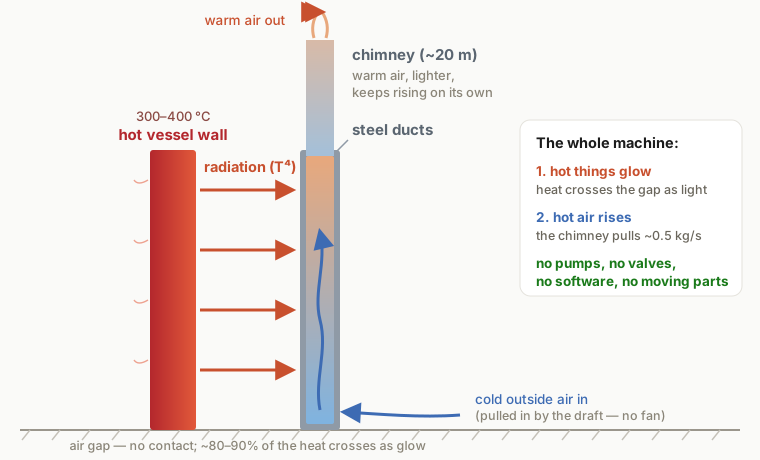
Two pieces of physics do all the work:
1. Hot things glow. Everything radiates heat as electromagnetic waves, at a rate that grows as the fourth power of absolute temperature (Stefan–Boltzmann: q ∝ T⁴). At room temperature it’s negligible. But a vessel wall at 300–400 °C beams heat across the air gap like an open oven door. No contact, no fluid, no fan — at these temperatures radiation carries roughly 80–90% of the heat to the duct wall. The gap is doing almost nothing; the glow is the transport.
The fourth power is also the safety feature. If the vessel gets 10% hotter (in absolute temperature), it radiates ~46% more heat. Heat removal accelerates faster than temperature rises. That’s a built-in negative feedback loop — a thermostat made of geometry.
2. Hot air rises. The air inside the ducts absorbs that radiated heat, warms by ~80–100 °C, becomes lighter than the outside air, and floats up the chimney — pulling fresh cold air in behind it. A 20-metre chimney with ~90 °C of warming generates a driving pressure of about 60 pascals. That’s 0.06% of atmospheric pressure — yet it silently pumps roughly half a kilogram of air per second through the system, day and night, for free, forever. (60 pascals is the pressure under six millimetres of water — driving the safety system of a nuclear plant.)
Chain them together and you get a machine with no parts: glow across the gap, float up the chimney. The hotter the accident, the harder both mechanisms work.
Don’t take my word for it — drag the sliders above (or open the calculator full-page). Drag the heat load, the outdoor temperature, and the wind, and watch the airflow and wall temperatures respond. The sliders drive a JavaScript port of the physics model the AI agents built and validated against the measurements; it runs entirely in your browser.
Proving it: a 26-metre rig in a building near Chicago
You don’t license a nuclear plant on “trust me, hot air rises.” Argonne National Laboratory built NSTF — a half-scale slice of the real thing: a 220 kW electrically heated steel wall playing the role of the hot vessel, twelve steel ducts, two chimneys through the roof, and ~400 sensors, run to nuclear QA standards for 33 months.
The centerpiece test: drive the heated wall with the exact decay-heat curve of a simulated depressurization accident — 3.5 days of slowly climbing then fading heat — and watch. The wall climbed to about 409 °C, flattened out below the steel limit, and came back down, tracking the decay curve the whole way. The reactor mock-up saved itself, on camera, with no moving parts.
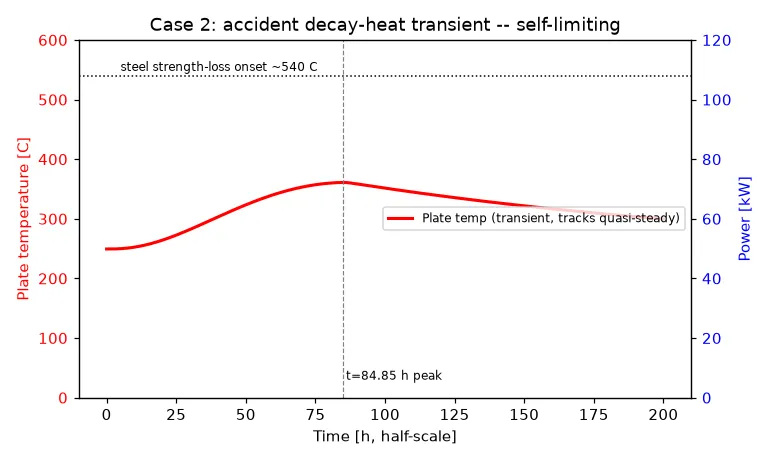 (This particular plot was produced by an AI agent predicting the test — the companion article’s story. The measured curve does the same thing, peaking at 408.7 °C.)
The surprise: the weather got a vote
Then the odd part. Argonne ran the same baseline test eight times over two years, and the answers kept shifting: airflow varied by ~25%, duct temperatures by 30 °C. Identical rig, identical power. The only thing that changed was the sky.
It makes perfect sense once you see it: the “pump” of this system is the density difference between the hot air inside the chimney and the cold air outside the building. In January, outside air near Chicago is dense; the draft is strong. In July, it’s light; the draft sags. The safety system literally runs better in winter. Wind matters too — gusts over the chimney outlets add suction (growing as wind speed squared), and one windy start-up attempt actually drove the flow backwards; the lab aborted that attempt, and the repeat succeeded.
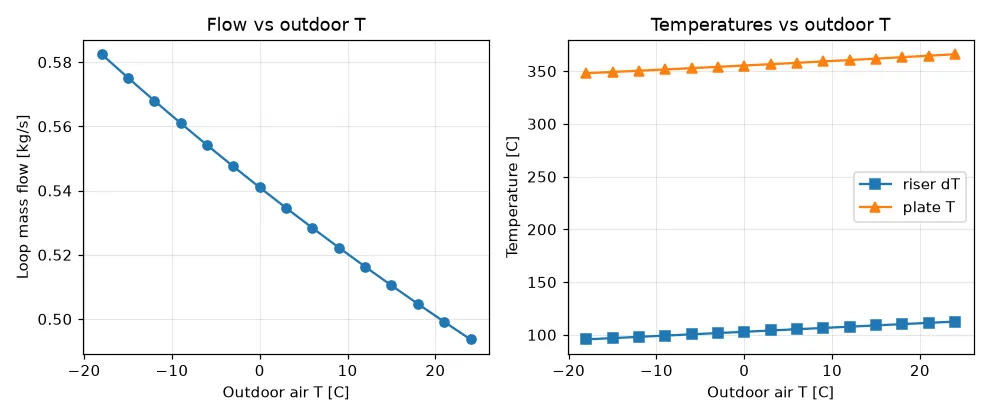
None of this breaks the safety case — the vessel temperature barely notices, because the T⁴ radiation clamp dominates — but it means a passive system’s performance envelope includes the weather report. The lab ended up fitting a little formula for the no-power airflow: ṁ = (5.53·ΔT + 3.75·V²)^(1/1.8) — temperature difference and wind speed in, kilograms of air per minute out.
(A coda from the companion experiment: asked to derive such a formula blind from the geometry, the AI produced ṁ = (20.5·ΔT + 6.25·V²)^(1/2) — the same structure, a wind term within ~10% of the lab’s fit, and a temperature term about 45% hot, having itself flagged the exact assumption responsible. Six minutes, $1.37.)
Why I’m telling you this
Two reasons. First, it’s the most elegant piece of engineering I know of: a nuclear safety system whose parts list is a wall, a gap, and a chimney, whose failure mode analysis is “physics stops working.”
Second: this experiment has something almost nothing else has — years of public, nuclear-grade measured data of a system doing pure physics. Which made it the perfect exam question for a different kind of test: whether an AI, given only the blueprints, could predict these measurements from first principles. That’s the companion article: I gave an AI the blueprints of a nuclear-safety experiment.